Your service page ranks for several familiar keywords, yet traffic keeps wobbling. Then a competitor appears in an AI recommendation you expected to earn. The reports show positions and clicks, but they can’t explain who prospects are discovering or why.
Modern search visibility covers every meaningful place a brand can appear: organic listings, SERP features, AI-generated summaries, citations, comparisons, and recommendations. To increase search visibility, a business must make its information accessible, relevant, credible, and useful across ranked results and AI-generated answers.
Visibility isn’t one universal rank anymore.
One prospect may click a conventional result, while another may discover your name during an AI-assisted journey before visiting your website later.
At eSEO Agency, we look beyond whichever dashboard happens to be shouting the loudest. We help you identify where visibility is slipping before our team recommends new content, technical repairs, or authority work.
First, let’s separate the signals created by Google results from those produced inside AI-generated answers and recommendations.
Search Results Don’t End With a List of Links
Search visibility now includes organic listings, local results, rich features, AI Overviews, conversational answers, citations, and recommendations. A brand can perform beautifully in one space while barely registering in another.
Traditional Google search visibility is measured through impressions, positions, SERP appearances, local listings, clicks, and the quality of resulting visits.
Read Each Signal for What It Proves
AI-generated experiences add mentions, linked citations, comparisons, and recommendations. These outcomes belong to the same customer journey, but they aren’t interchangeable:
- Rankings create opportunities to be seen.
- Citations identify sources used in an answer.
- Traffic confirms that someone visited the website.
- Conversions record a meaningful customer action.
Search would be suspiciously convenient if one automatically produced the next. Separate reporting prevents a lively dashboard from disguising a quiet sales pipeline.
Google’s guidance for generative AI features confirms that its generative features draw on the Search index and core ranking and quality systems. Established SEO practices still support both environments.
Businesses need one connected strategy, not a funeral for Google or a frantic chase after every new AI platform. Neither channel replaces the other.
Google Results and AI Answers Measure Different Outcomes
| Dimension | Google results | AI-generated answers |
| User action | Searches and selects results | Asks and refines questions |
| Visibility event | Impression or SERP appearance | Mention, citation, or recommendation |
| Common measurement | Position, clicks, CTR, traffic | Inclusion, citations, context, referrals |
| Main limitation | A ranking may not earn a click | A mention may not include a link |
| Shared requirement | Useful, accessible, credible information | Useful, accessible, credible information |
Find the Missing Step Before Rewriting the Page
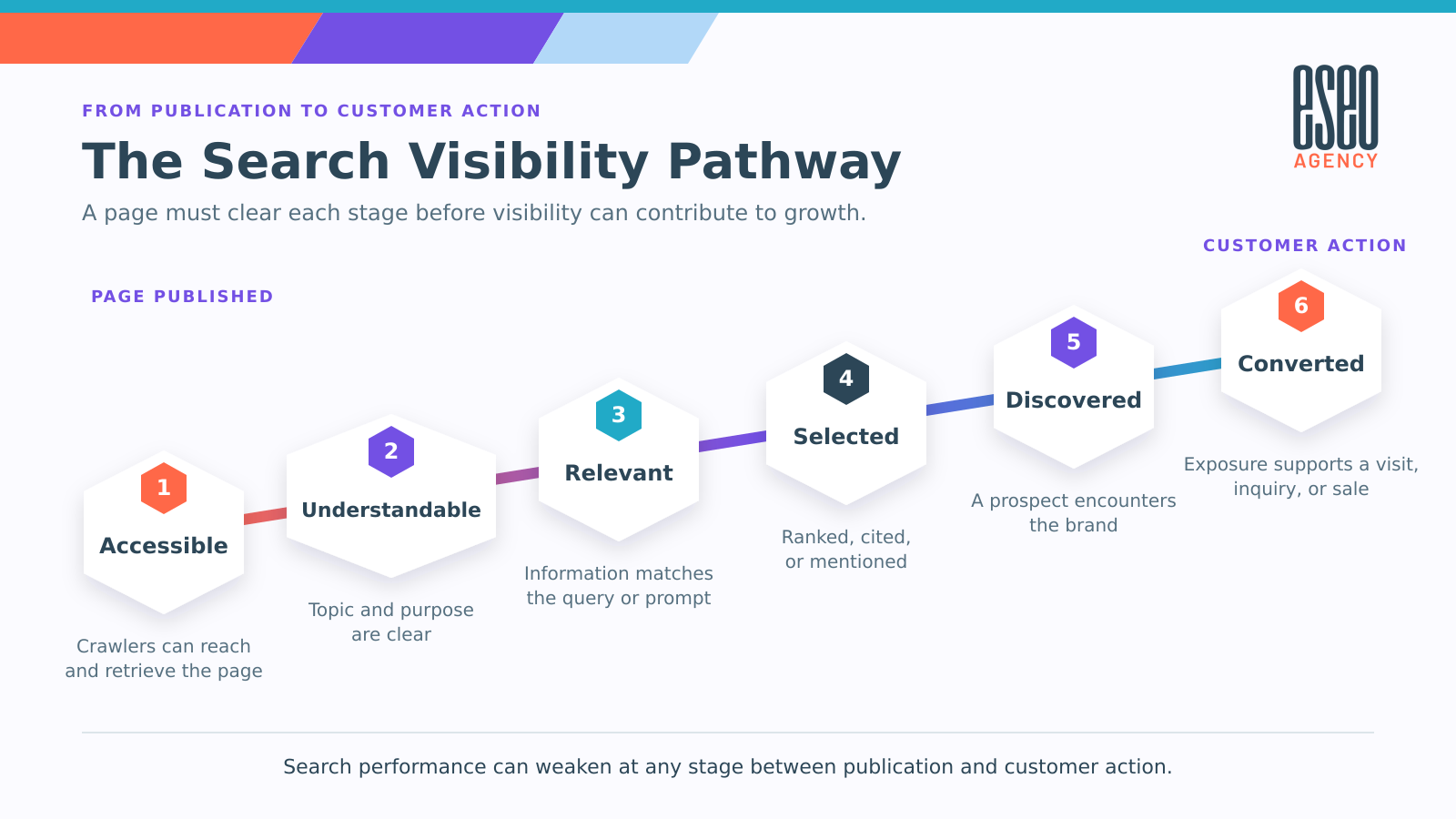
Publishing a page makes it available; it doesn’t automatically make it visible. Search systems still need to reach it, understand it, match it with a useful request, and decide that it deserves space in a result or answer. A polished article can quietly fail at any point in that sequence.
Follow the page through six checkpoints:
- Crawlers can access the URL.
- The content can be indexed or retrieved.
- The topic, purpose, and intended audience are clear.
- The information matches a relevant query or conversational prompt.
- The page or brand earns a ranking, citation, or mention.
- That exposure contributes to a visit, branded search, inquiry, or conversion.
Let the Symptom Point to the Repair
Your team should identify the failing checkpoint before making changes to increase website visibility. Otherwise, a content problem gets ‘fixed’ with technical work, or an indexing problem receives another lovely blog post that nobody can find.
- No impressions can indicate blocked access, indexing trouble, or weak query relevance.
- Impressions without clicks can reveal an unclear title, poor alignment, or unhelpful result presentation.
- Rankings without AI mentions can expose missing context, evidence, or external corroboration.
- Mentions without inquiries can signal an attribution, landing-page, or conversion gap.
Once the gap is visible, the next action becomes far easier to justify.
Give Search Systems a Clear Route to Your Best Work
Technical AI search engine optimization techniques extend sound technical SEO; they aren’t a secret collection of tags reserved for machines. Before a page can compete anywhere, search systems need permission to access it, a stable URL to process, and content they can render clearly.
Even excellent advice stays invisible when the route leading to it is blocked.
Check the Route, Not Just the Destination
An access audit should examine:
- robots.txt and noindex directives, which can allow crawling while still preventing indexing.
- Canonical URLs, HTTP response codes, and XML sitemaps, which help systems identify the preferred, available page.
- Internal links and accessible navigation, so important content isn’t stranded several clicks away.
- JavaScript rendering, especially when essential copy appears only after an interaction.
- Mobile usability and page performance for the people who arrive after discovery.
Separate Search Access From Model Training
OpenAI’s crawler documentation distinguishes OAI-SearchBot, which supports inclusion in ChatGPT search, from GPTBot, which concerns potential foundation-model training. Site owners can manage those permissions separately, allowing search discovery without automatically granting the same access for training.
You decide which public information search systems may access. Our team audits the setup, documents barriers, and recommends changes; your developers then implement approved updates when their involvement is needed.
Technical eligibility creates an opportunity, not a promise. Even a fully accessible page isn’t guaranteed indexing, ranking, citation, or recommendation but clearing the route gives useful work a fair chance to be found.
Follow the Questions Behind the First Query
A short Google query rarely captures the whole decision. Someone searching ‘AC repair near me’ may soon ask an AI assistant about costs, replacement timing, weekend availability, and provider trust. One search has become a conversation with context.
Map the Decision, Not Every Wording
Useful research follows the buyer’s decisions:
- Discovery and education: What happened, and how urgent is it?
- Comparison and suitability: Should the customer repair or replace the unit?
- Local availability and commitment: Who serves the area, when can they come, and what might it cost?
- Implementation and validation: What happens after booking, and what evidence supports the provider?
Coverage across related prompt groups gives a more realistic view of AI search visibility than one test response. Google calls part of this process query fan-out: a complex question can generate several related searches behind its answer.
One resource may cover connected questions, while genuinely different intents deserve separate pages. Thin variations add volume, not value.
Watch One HVAC Journey Expand
- Google: “AC repair near me”
- Comparison: “Repair or replace a ten-year-old AC?”
- AI: “Which local HVAC provider offers weekend repairs and explains replacement costs before booking?”
Service pages establish availability, local details confirm coverage, FAQs explain the process, comparison content supports the decision, and reviews provide independent validation.
Pew Research Center’s 2025 U.S. browsing study found AI summaries on 53% of searches with ten or more words, compared with 8% of one- or two-word searches.
Publish What Another Page Can’t Easily Replace
Original usefulness comes from what your business genuinely knows, can show, and can explain. Search systems don’t need decorative formatting or a keyword repeated until it loses all meaning. They need specific information that helps a person understand a problem, compare choices, or act with confidence.
Give the Page Evidence of Its Own
Useful assets may include:
- First-party observations, original surveys, internal data, and client-approved case examples
- Expert commentary, documented processes, and before-and-after explanations
- Decision frameworks and comparison tables
- Screenshots, purpose-built diagrams, and recent authoritative references
Publishing these assets can increase search visibility because the page contributes evidence or insight another writer can’t casually reproduce.
Let E-E-A-T Show Up in the Work
- Experience connects advice with real situations.
- Expertise keeps explanations accurate and useful.
- Authoritativeness grows through recognized subject coverage.
- Trustworthiness depends on sourcing, transparency, and current information.
Make the Answer Easy to Use
Answer the main question early, then add the detail needed to support it. Descriptive headings, sourced claims, decision-specific examples, and author or reviewer context help readers evaluate the page quickly. They also make useful passages easier to extract for featured snippets and generated answers without turning the article into a filing cabinet of tiny ‘AI chunks’.
“We offer excellent customer service” says almost nothing. Response times, service boundaries, support steps, documented outcomes, and an honest explanation of what customers can expect provide real substance.
Google doesn’t require microscopic content blocks, and schema isn’t a recommendation ticket. Accurate markup can clarify eligible information, but neither formatting nor code can guarantee selection.
Let the Rest of the Web Confirm the Story
Your website explains who you are, what you offer, and why customers should care. Independent sources help search systems verify that story by confirming the business’s existence, relevance, location, experience, and reputation. Agreement across the web makes the brand easier to identify without forcing every source to recite the same polished paragraph.
Keep the Facts in Agreement
Review essential information across:
- Your website, Google Business Profile, and Bing Places
- Relevant industry directories and professional associations
- Review platforms and supplier or partner profiles
- Social profiles and credible local publications
Names, primary services, locations, service areas, hours, categories, website URLs, and contact details should agree. Consistency protects the underlying facts; it doesn’t require copying one promotional paragraph everywhere. Accurate customer evidence also supports local relevance and real-world experience.
Give Owned Pages a Clear Job
At eSEO Agency, our SEO content writing services clarify your services, industries, locations, processes, expertise, and named authorship on pages you control. You supply operational knowledge and approve the claims; we shape that information into useful, accurate content with defined ownership.
Reviews, directory entries, partner mentions, and media coverage must remain authentic. Fake praise, manufactured discussions, and bulk placements in irrelevant directories create noise and risk. Search systems need credible corroboration, while prospective customers deserve a version of the business they’ll actually recognize after making contact.
Measure Visibility Without Mistaking It for Growth
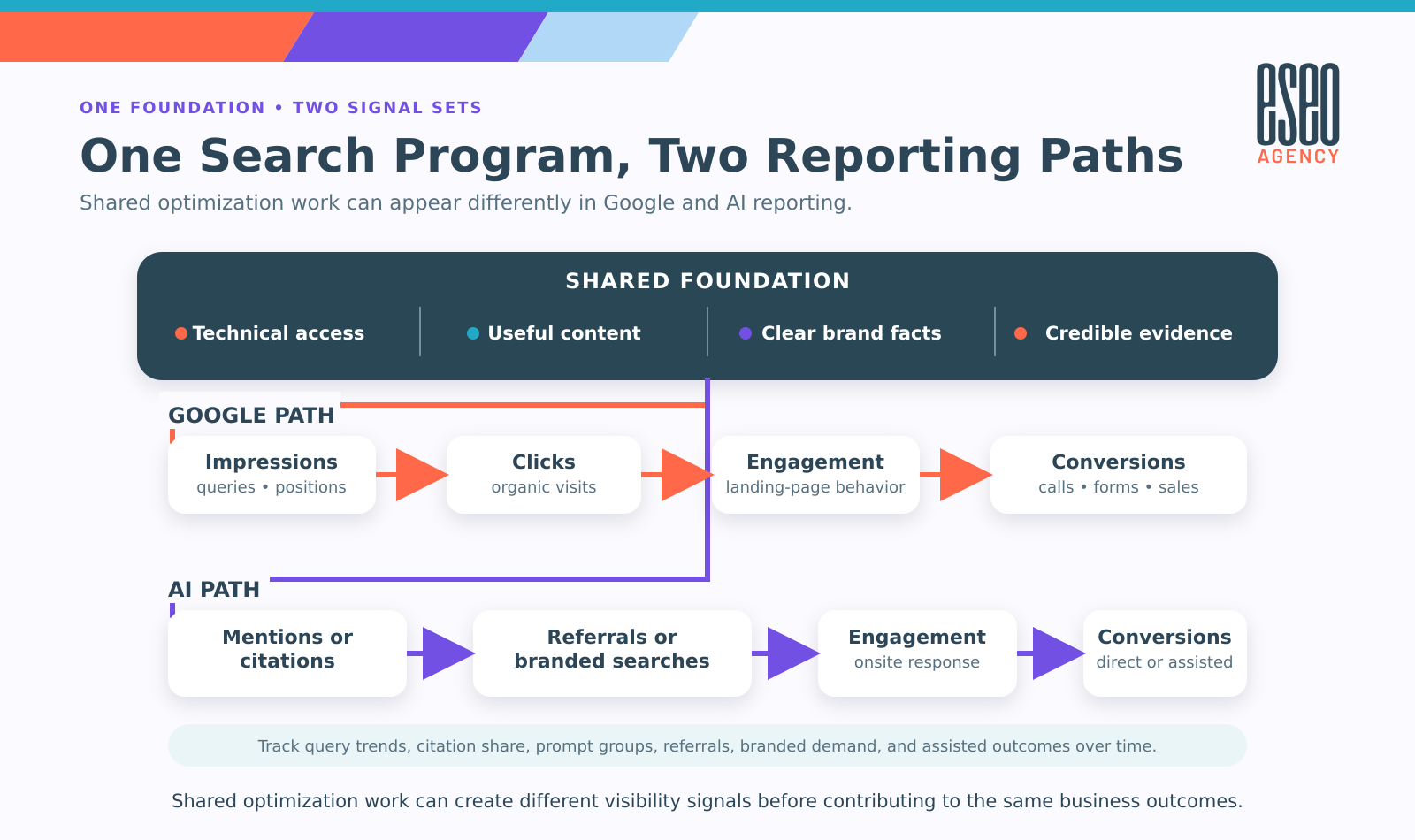
Visibility can rise without producing revenue, which makes a cheerful chart surprisingly easy to misread. Comparing AI SEO vs. traditional SEO reveals overlapping foundations but different reporting signals. A useful report should show where the business appears, how people respond, and what commercial movement follows.
Keep Three Reporting Layers Separate
- Availability: Crawling, indexing, eligible pages, and technical health
- Visibility: Impressions, rankings, mentions, citations, and inclusion
- Business impact: Qualified visits, branded demand, calls, forms, leads, sales, and assisted conversions
Each layer answers a different question. Blending them can make a citation look like a customer or a click look like a sale.
Use More Than One Dashboard
Combine several evidence sources:
- Google Search Console for queries, impressions, clicks, CTR, positions, and indexed performance
- Analytics for landing pages, AI referrals, engagement, calls, forms, and conversions
- Microsoft’s AI visibility reporting guidance for supported citations, cited pages, topics, intents, and citation share
- A repeatable prompt library for directional monitoring across other platforms
- Sales forms or intake questions asking how prospects discovered the company
Treat AI Results as Samples
AI answers can change by location, session, model, prompt wording, and time. Manual checks and third-party scores therefore provide directional evidence, not fixed rankings. Track patterns across prompt groups and reporting periods instead of throwing a small parade for one flattering answer.
ChatGPT search referrals may include utm_source=chatgpt.com, which helps analytics identify some visits. The parameter remains incomplete because it can’t reveal every mention, unseen conversation, branded search, or assisted journey.
Read every metric beside the question it answers. Visibility becomes useful when the report connects technical access and discovery with customer action without pretending that one number explains the entire journey.
Match Each Metric to the Question It Answers
| Metric | What it reveals | What it can’t prove alone |
| Impressions | Pages appeared in Google | Searchers noticed or trusted them |
| Organic clicks | Users visited from results | The visit produced revenue |
| AI mentions | The brand entered an answer | The website supplied the source |
| Citations | A page supported an answer | The citation earned a click |
| AI referral sessions | Visitors arrived from an AI platform | Every AI-assisted interaction |
| Leads and sales | Visibility contributed to action | Which unseen touchpoint began the journey |
Make Every Search Path Lead Back to Your Business
Bring us your website, priority services, target locations, search reports, and visibility concerns. We’ll identify which stages need technical, content, authority, or measurement support before recommending your next move.
Our customized strategy may combine technical and content audits, keyword and intent research, on-page and off-page coordination, content planning and optimization, Google and AI visibility monitoring, and transparent reporting. Each plan reflects your market, audience, competition, and service reach.
Search performance develops at a different pace for every business, so we set practical expectations and focus our work on measurable progress across the complete discovery journey.
To explore how eSEO Agency can help your business increase search visibility across the USA, call (252) 513-9681 or request a quote through our website. Let’s uncover the next sensible step for your search presence.
Frequently Asked Questions
Can You Guarantee a Google Ranking or AI Recommendation?
Specific rankings and AI recommendations can’t be guaranteed because results vary across searches, locations, and platforms. We focus on improving technical access, content, authority signals, and measurement practices that support greater eligibility, visibility, and steady progress.
How Long Can Search Visibility Improvements Take?
Timelines depend on your site’s technical condition, current authority, competition, content depth, crawl frequency, and required work. We establish a clear baseline, prioritize the gaps, and report progress without inventing one deadline for every campaign.
Can We Improve Existing Pages Instead of Publishing New Ones?
Yes. We can optimize content for AI search engines by clarifying intent, updating evidence, improving internal links and organization, and adding missing decision details. We recommend a new page only when a genuine topic gap exists.
What Access Will You Need Before Starting?
We request only the access relevant to the agreed scope, which may include Search Console, analytics, your content management system, Bing Webmaster Tools, business profiles, and existing reports. You retain control of every account and permission.
Can You Work With Our Current Marketing or Development Team?
Yes. Our specialists can research, audit, plan, write, optimize, and report while your marketers, subject experts, and developers contribute business knowledge, approvals, and implementation support. We document responsibilities early so every task has a clear owner.
How Will You Report Google and AI Performance?
Our reports separate technical health, conventional search performance, AI mentions and citations, referral traffic, and business outcomes. We explain what each metric proves and what it can’t, so a visibility score isn’t mistaken for leads or revenue.
What Should We Expect From an SEO Partner?
A dependable SEO solution company should provide a documented scope, realistic expectations, assigned responsibilities, transparent access, approved recommendations, and meaningful reporting. We also explain our findings in plain language, so you understand the work and its purpose.
Can You Support a U.S. Business With Local or National Goals?
Our AI SEO services in the USA can support local, regional, and national goals. We shape your plan around actual locations, industries, audiences, competitors, and service reach instead of squeezing every business into the same coast-to-coast campaign.