AI search engines recommend brands that consistently demonstrate trust, expertise, authority, and relevance across the web, not simply those that rank for keywords.
AI-powered search is transforming how people find information online. Instead of presenting a page full of links and leaving users to sort through them, modern search experiences increasingly provide direct answers, recommendations, summaries, and brand suggestions.
As a result, businesses can no longer rely solely on traditional rankings to earn visibility. At its core, AI search uses artificial intelligence to analyze information from multiple sources and generate answers that best match a user’s intent.
This means search platforms are becoming more selective about which websites, businesses, and experts they choose to reference. Visibility is no longer just about appearing in search results. It’s about becoming a source that AI trusts enough to recommend.
For many business owners and marketing teams, this shift can feel confusing. The SEO strategies that worked five years ago aren’t disappearing, but they are evolving.
You may be wondering why some brands appear repeatedly in AI-generated answers while others remain invisible. You may also be asking how your business can adapt before competitors gain an advantage.
The good news is that the fundamentals of trust and authority still matter. The difference is that AI can evaluate those signals in more sophisticated ways than ever before. Let’s explore how AI search works and what businesses can do to improve their visibility in this new search landscape.
What Are AI Search Engines?
AI search engines use artificial intelligence to understand questions, interpret context, evaluate sources, and generate direct answers for users. Unlike traditional search engines that primarily display a list of web pages, AI-powered platforms attempt to provide the best answer immediately.
This shift changes how people interact with search. Instead of entering short keyword phrases, users increasingly ask complete questions and expect conversational responses. AI systems analyze vast amounts of information and determine which sources are reliable enough to support those responses.
Questions such as how can AI SEO services improve my website’s visibility are becoming increasingly common as organizations adapt to AI-powered search.
Today, several major platforms are shaping the future of AI-powered search:
- Google AI Overviews
- ChatGPT Search
- Perplexity
- Gemini
- Microsoft Copilot
According to 2026 AI search market data, AI platforms are now capturing an estimated 15–20% of informational query volume, with Google’s AI Overviews appearing on a growing share of informational searches, underscoring how quickly this shift is
How AI Decides Which Brands to Show in Search Results
AI systems evaluate hundreds of signals before determining which brands deserve visibility. While each platform uses different algorithms and models, several factors consistently influence recommendations.
Brand Authority
One of the strongest signals AI evaluates is brand authority. Simply put, authority refers to how trustworthy and established a business appears across the internet. Think about how humans make recommendations. If several respected professionals consistently mention the same company, you’re more likely to trust that company.
AI systems work similarly. They analyze mentions, citations, reviews, references, and industry recognition to determine whether a brand deserves attention. A business that appears in reputable publications, contributes expert insights, and maintains a consistent online presence often sends stronger authority signals than a company with little recognition outside its own website.
This is one reason why established brands frequently appear in AI-generated answers. They have built credibility over time, and AI systems can detect that pattern. However, smaller businesses should not assume they cannot compete. Many niche companies outperform larger competitors because they demonstrate deep expertise within a specific industry. AI increasingly rewards relevance and authority rather than size alone.
High-Quality Content
Content remains one of the most important factors influencing visibility.
AI search systems are designed to provide useful answers. To do that effectively, they must identify content that is accurate, helpful, and trustworthy. Pages that genuinely solve user problems tend to perform better than content created solely to target keywords. High-quality content typically explains topics clearly, answers related questions, and demonstrates subject matter expertise. Instead of focusing on search engines, it focuses on helping readers make informed decisions.
Originality is equally important. AI systems can often identify content that simply repeats existing information without adding value. Businesses that publish unique insights, practical examples, and expert guidance are more likely to stand out.
The strongest content generally:
- Answers specific user questions
- Provides expert insights
- Includes current information
- Demonstrates real-world experience
Topical Authority
Publishing a single article about a subject is rarely enough to establish expertise. AI systems increasingly evaluate how thoroughly a website covers a topic. This concept is known as topical authority. Rather than looking at individual pages in isolation, AI examines whether a business consistently demonstrates knowledge across an entire subject area.
For example, a company offering international SEO services should ideally create content about multilingual SEO, international keyword research, hreflang implementation, global content strategies, localization, and country-specific search behavior. When a website covers a topic comprehensively, AI gains greater confidence in recommending that source. Businesses that invest in content clusters often create stronger authority signals than those publishing disconnected articles.
EEAT Signals
Google’s EEAT framework continues to influence modern search visibility and remains highly relevant in AI-driven search environments.
EEAT stands for Experience, Expertise. Authoritativeness, Trustworthiness. AI systems increasingly look for evidence that content comes from knowledgeable individuals or organizations with real-world experience. For example, author biographies, professional credentials, case studies, industry recognition, and transparent company information all contribute to stronger EEAT signals.
A website that clearly demonstrates who created the content and why they are qualified often earns greater trust than anonymous content with little supporting information.
Structured Data
Structured data helps search engines understand information more effectively. While users rarely see schema markup, search systems rely on it to interpret important details about a website. Structured data can clarify who published the content, who wrote it, what the page discusses, and how different pieces of information connect.
Several schema types commonly support search visibility, including Organization Schema, Article Schema, FAQ Schema, and Author Schema. Think of schema as additional context for search engines. It helps AI interpret information accurately rather than making assumptions. As AI search becomes more sophisticated, providing clear context through structured data becomes increasingly valuable.
Backlinks and Mentions
Backlinks continue to play an important role in determining authority. When reputable websites link to your content, they effectively signal trust. AI systems recognize these endorsements and often consider them when evaluating credibility.
However, modern AI platforms appear to look beyond backlinks alone. Brand mentions, citations, expert interviews, media coverage, and industry references can all contribute to visibility. A company that regularly appears in respected industry conversations often develops stronger authority signals than one that focuses exclusively on link-building tactics. The goal is not simply collecting links. The goal is building a reputation.
User Experience
AI systems aim to recommend websites that create positive user experiences.
If visitors arrive on a website and immediately encounter slow loading times, confusing navigation, or difficult-to-read content, trust can decrease.
User experience factors such as page speed, mobile usability, readability, and engagement all contribute to how search systems evaluate quality. Visitors should be able to find information quickly and navigate a website without frustration. In many cases, technical improvements that benefit users also strengthen search visibility.
How to Improve Brand Visibility in AI-Powered Search
Understanding AI evaluation criteria is helpful, but businesses also need actionable strategies.
The following approaches can help strengthen visibility across AI-powered search platforms.
Build Topical Authority
One of the most effective ways to improve visibility is by creating comprehensive content around your core expertise. Rather than publishing isolated articles, focus on building content clusters that cover related subjects in depth. This allows search systems to recognize your website as a trusted resource within a specific niche.
For example, a business focused on AI SEO could develop content covering:
- Generative Engine Optimization (GEO)
- Entity SEO
- Schema markup
- AI visibility strategies
- Technical SEO
- Content authority
The broader and deeper your coverage, the stronger your topical authority becomes.
Create Helpful Content
Helpful content remains the foundation of successful SEO. Many businesses focus so heavily on rankings that they forget the purpose of content. Users visit websites because they need answers, solutions, or guidance. Before creating content, ask yourself: What problem is the user trying to solve?
Answering that question often leads to stronger content than focusing solely on keywords.
The best-performing content typically addresses real concerns, explains complex ideas clearly, and provides actionable information readers can use immediately.
Optimize for Semantic Search
Modern search systems understand context far better than previous generations of search engines. Instead of relying on exact keyword matches, AI evaluates relationships between topics, entities, and concepts. This means businesses should write naturally while incorporating relevant terminology, supporting concepts, and question-based content. Semantic optimization often includes:
- Related keywords
- Industry entities
- Natural language phrases
- Question-focused headings
These elements help AI understand content more accurately.
Strengthen Your Brand Presence
AI systems evaluate more than just your website. They also analyze your broader digital footprint. Businesses that maintain a strong presence across trusted platforms often develop stronger authority signals.
This may include industry directories, review platforms, professional associations, social media profiles, and media publications. When AI encounters consistent references across multiple credible sources, confidence in the brand increases. Visibility is no longer confined to a single website. It is built across the digital ecosystem.
Improve Technical SEO
Working with an experienced SEO services company in USA can help businesses identify authority gaps, strengthen content strategies, and improve technical SEO foundations that support long-term visibility.
Businesses should regularly evaluate:
- Core Web Vitals
- Site speed
- Indexing health
- Internal linking
- Schema implementation
- Mobile usability
These technical foundations help search systems access and understand content more efficiently.
Earn High-Quality Backlinks
Authority-building remains essential.
Instead of pursuing large quantities of links, focus on earning mentions from trusted sources within your industry.
Original research, expert commentary, industry partnerships, and digital PR campaigns often generate stronger results than traditional link-building tactics.
Quality consistently outweighs quantity.
Keep Content Fresh
Information changes quickly, especially in digital marketing and technology. Outdated content can reduce trust and weaken visibility signals. Businesses should regularly review important pages and update statistics, examples, screenshots, and recommendations. Fresh content demonstrates ongoing expertise and helps maintain relevance in evolving search environments.
Common Mistakes That Reduce AI Search Visibility
Many websites struggle to gain traction because AI search engines have difficulty identifying trust and authority signals. As a result, even businesses that invest in content marketing may see limited results from their AI search visibility service efforts.
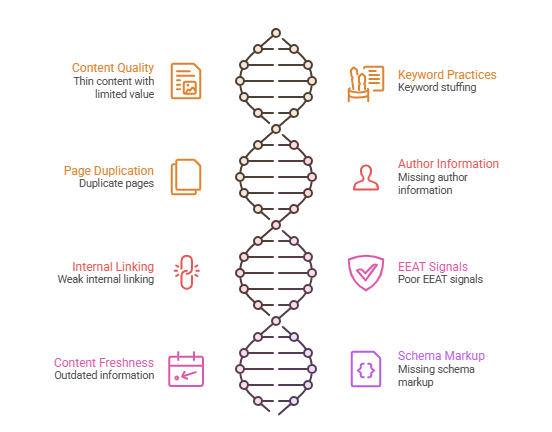
- Thin content with limited value
- Keyword stuffing
- Duplicate pages
- Missing author information
- Weak internal linking
- Poor EEAT signals
- Outdated information
- Missing schema markup
These problems make it harder for AI systems to recommend a website confidently. The solution is often less complicated than businesses expect. Improving quality, clarity, trust, and structure usually produces meaningful results.
The Future of AI Search Optimization
AI-powered search is rapidly becoming a standard part of the online experience. Users increasingly expect direct answers rather than lists of links. Search platforms continue investing heavily in AI capabilities, and this trend is unlikely to slow down. As AI in search engines continues to evolve, businesses will need to focus more on authority, trust, and topical expertise rather than relying solely on traditional ranking factors.
The businesses that succeed will be those that consistently build trust and demonstrate expertise.Instead of chasing short-term ranking tactics, forward-thinking organizations are investing in authority, content quality, and user experience.Those efforts create advantages that AI systems can recognize and reward over time.
Why Businesses Need AI SEO Services
As AI search becomes more sophisticated, businesses need strategies specifically designed for this new environment. Traditional SEO remains important, but modern visibility requires additional expertise in AI Search Optimization, technical SEO, entity development, content strategy, schema implementation, GEO, local SEO, and enterprise SEO.
This is where professional guidance becomes valuable. Businesses seeking an experienced SEO services company in the USA often discover that AI visibility requires a coordinated approach focused on the improvement of a web pages visibility across both traditional and AI-powered search results.
The answer lies in creating a strategy that aligns with how modern AI systems evaluate trust, relevance, and authority. Services such as AI search visibility, AI search engine optimization, and international SEO consulting services help businesses strengthen their digital presence and improve their chances of appearing in AI-generated recommendations.
Build a Brand That AI Wants to Recommend
The future of AI search engines belongs to businesses that prioritize trust, authority, expertise, and user value. As AI-powered search continues expanding, organizations that invest in high-quality content, strong technical foundations, topical authority, and brand credibility will be better positioned for long-term visibility.
If your business is ready to strengthen its presence in AI-powered search, let the team at eSEO Agency help you build a strategy tailored to your goals. From AI Search Optimization and technical SEO to schema implementation, content development, GEO, and enterprise-level solutions, their specialists help businesses stand out where it matters most.
We help you improve visibility, strengthen authority, and create a digital presence that earns attention from both users and AI systems.
Frequently Asked Questions
How Do AI Search Engines Recommend Brands?
AI search engines evaluate factors such as content quality, authority, EEAT signals, backlinks, brand mentions, technical SEO, and user experience before recommending brands.
What is AI Search Optimization?
AI Search Optimization is the process of improving a website’s visibility in AI-generated answers, recommendations, and search summaries.
Does SEO Still Matter for AI Search?
Yes. Traditional SEO remains important because AI systems still rely on well-optimized, crawlable, and authoritative content when generating answers.
What is Generative Engine Optimization (GEO)?
Generative Engine Optimization (GEO) focuses on helping brands become visible within AI-generated search responses and conversational search experiences.
How Can My Website Appear In AI Search Results?
Businesses can improve visibility by building topical authority, publishing helpful content, implementing schema markup, strengthening EEAT signals, and earning authoritative mentions.
How Do Search Engines Decide Which Websites to Rank?
Understanding how brands rank on google starts with recognizing that search engines prioritize content that delivers genuine value to users. Brands improve their rankings by creating helpful, relevant content, demonstrating expertise, and consistently addressing the topics their audience is searching for.
Does ChatGPT Use Google Rankings?
Not directly. However, many of the trust and authority signals that influence Google rankings can also influence visibility in AI-powered search environments.
What Factors Improve AI Search Visibility?
Content quality, brand authority, backlinks, structured data, topical expertise, user experience, and technical SEO all contribute to stronger AI search visibility.