Someone searches for a question your blog answers perfectly. But instead of clicking through to your page, they ask ChatGPT, open Google AI Mode, or read an AI-generated summary. They get what they need and move on.
So, where does that leave the useful content you worked so hard to rank?
That question sits at the heart of AI search optimization.
That shift changes what blog visibility means. To optimize your blog for AI engines, you need content that people find genuinely useful and that search systems can discover, interpret, trust, and distinguish from generic coverage.
AI-search blog optimization improves a page’s usefulness, authority, structure, context, and technical accessibility so relevant information can be retrieved and referenced confidently when it best answers a question.
Key Takeaways:
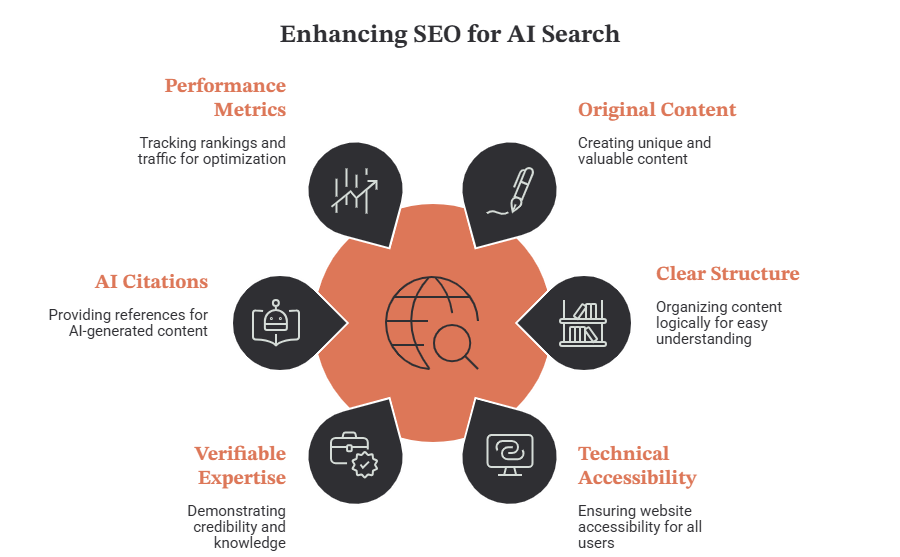
- AI search adds a new discovery layer without replacing core SEO fundamentals.
- Useful, original, experience-backed content gives search systems something distinctive to reference.
- Clear structure, contextual relationships, technical accessibility, and verifiable expertise all support visibility.
- AI citations aren’t governed by magic formats, schema tricks, or rigid content ‘chunking’ rules.
- Measure rankings and traffic alongside AI mentions, citations, branded demand, and conversions.
AI Search Changes Discovery Over the Need for SEO
Traditional search usually gives users a ranked set of resources to explore. Generative search can change that experience by retrieving relevant information, comparing sources, and synthesizing what it finds into a direct response. The information still has to come from somewhere.
One Question Can Trigger Several Searches
Google’s generative Search features, for example, remain connected to its Search index and core ranking and quality systems. Google explains that retrieval-augmented generation (RAG) can ground responses in relevant, current pages, while query fan-out lets AI Mode issue multiple related searches across subtopics.
One detailed question can therefore open several avenues of retrieval at once.
Also, GEO Adds to SEO. It Doesn’t Replace It.
Terms such as Generative Engine Optimization (GEO) and Answer Engine Optimization (AEO) describe this expanding visibility work, but they don’t make established SEO irrelevant.
In fact, Google’s current guidance for generative AI search treats these practices as part of SEO itself. Effective AI search engine optimization still depends heavily on useful content, crawlability, relevance, authority, and sound technical foundations.
10 Ways to Prepare Your Blog for AI Search
AI search doesn’t call for tearing up everything you know about SEO. The next ten practices show where to sharpen your approach, what deserves closer attention, and which familiar fundamentals are still carrying real weight.
1. Research the Questions Behind the Keyword
A keyword tells you what someone searched, but not everything they’re trying to figure out. Google’s query fan-out can branch a complex question into related searches, so your research should look beyond the primary phrase.
Ask what could logically come next:
- What does the reader need to know first?
- What would they compare before deciding?
- Which costs, limitations, locations, or requirements could change the answer?
- Are they learning, comparing options, or getting ready to buy?
A practical way to optimize content for AI search is to map those questions before writing. Someone searching ‘best accounting software’, for example, may also care about company size, integrations, pricing, industries, and migration.
Cover those connections where they add genuine value. Don’t spin every possible follow-up into a thin standalone page; Google specifically cautions against scaled content created primarily to manipulate search visibility.
2. Give the Answer Before Making Readers Hunt for It
Readers shouldn’t need a six-paragraph warm-up before discovering what your section actually answers. If a heading promises an explanation, give them the useful part early. Define unfamiliar terms when necessary, then use the paragraphs that follow to add evidence, conditions, examples, or exceptions.
Answer-first doesn’t mean answer-only!
Let the format follow the information. Bullets work nicely for grouped ideas, numbered steps make a process easier to follow, and a comparison may deserve a table. A complex answer, meanwhile, may need several paragraphs to explain properly.
The same thinking applies to effective SEO content writing services: content still has to serve the person reading it. Clear, self-contained passages can make information easier to retrieve, but don’t carve every paragraph into an artificial ‘AI chunk’.
Useful structure should improve the reading experience, not make your blog sound like a database.
3. Publish Information an AI Can’t Get Everywhere Else
If your article simply rearranges information already available across ten other websites, there’s little reason for it to become the source worth referencing. Google’s own generative Search guidance puts particular weight on useful, original, non-commodity content.
Give the web something it didn’t already have.
And that might include:
- Original survey findings, internal benchmarks, or measured results
- First-hand observations from a project or tested process
- Commentary from someone who works directly in the field
- Screenshots, demonstrations, or real case examples
- Limitations, unexpected outcomes, and lessons learned
Consider the difference between another article covering ‘10 benefits of email marketing’ and a report explaining what actually happened across 50 email campaigns. One summarizes familiar knowledge; the other contributes evidence.
You don’t need proprietary research for every post.
Even specific experience and expert interpretation can add something generic summaries can’t. That originality helps readers make better decisions while giving search systems a distinctive, attributable source to reference.
4. Build Clear Topic and Entity Relationships
Search systems don’t have to rely on one repeated keyword to understand what a page discusses. They can also interpret entities (identifiable people, organizations, products, places, services, and concepts) and the context connecting them.
Your AI SEO strategy should therefore make those relationships clear without manufacturing them for search engines. Build supporting coverage where readers genuinely need it, connect useful related pages internally, and keep facts such as services, locations, product names, and organizational details consistent across your site.
The nature of entity relationships also changes with the business context.
| Local business entity | National business entity |
| 📍 Local Contractor ↳ Service ↳ Location ↳ Qualifications ↳ Local experience |
🌐 National SaaS Company ↳ Platform ↳ Use case ↳ Integrations ↳ Industries served |
Both are building topical understanding, but their relevant relationships look very different. Rather than repeating the same phrase throughout a blog, give readers enough connected information to understand what you know, where it applies, and how the pieces fit together.
5. Structure Content Around Clear, Complete Ideas
Good structure should help a reader find their bearings, not make your article feel assembled for a machine.
You’re seeing that principle at work right now:
- one H1 establishes this guide’s topic,
- H2s divide the broader discussion,
- numbered H3s organize the ten practical ideas,
- and shorter paragraphs, lists, and visuals make the technical detail easier to navigate.
One practical way to optimize your blog for AI engines is to match the format to the information. Keep paragraphs manageable, use numbered steps for sequences, and reserve tables for comparisons that become clearer side by side. Plain, specific language also reduces ambiguity for readers and search systems alike.
Just don’t mistake good structure for an AI formatting formula. Current Google guidance says there’s no requirement to break content into tiny ‘chunks’ for generative Search. A useful answer may take 40 words or several paragraphs.
Give each section enough context to make sense on its own, but let the subject decide how much explanation it deserves. Structure should clarify the thinking, not dictate it.
6. Strengthen the On-Page Signals Around the Article
AI may change how an answer appears, but it hasn’t removed the need for search systems to access and understand the page behind it. Google says a page must still be indexed and eligible to appear with a Search snippet to qualify for its generative Search features.
Keep the surrounding signals in order:
- Search presentation: descriptive title and useful meta description
- Page clarity: sensible URL, meaningful image alt text, relevant internal anchors
- Technical access: crawlability, indexability, and canonicalization where needed
- User experience: mobile usability and page experience
Professional On page SEO services in the USA bring these pieces together with crawlability and indexability. AI search has expanded the destination for optimized content; it hasn’t eliminated the technical route that gets content discovered.
7. Make Expertise and Trust Verifiable
Expertise carries more weight when readers can verify where it comes from. Treat E-E-A-T experience, expertise, authoritativeness, and trustworthiness as something your content demonstrates rather than a badge you claim.
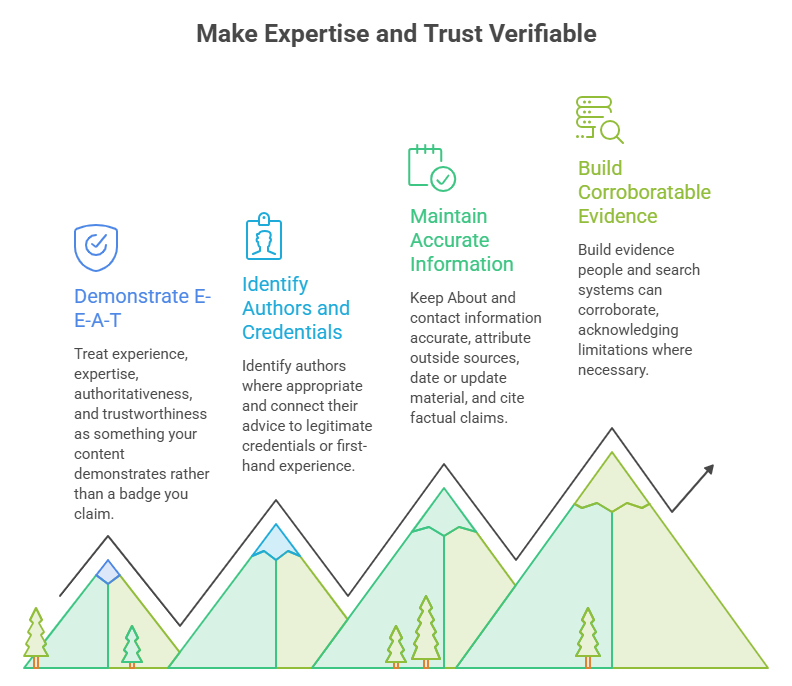
Identify authors where appropriate and connect their advice to legitimate credentials or first-hand experience. Keep About and contact information accurate, attribute outside sources, date or update material where freshness matters, and cite factual or statistical claims. If evidence has limitations, say so.
Transparency can be more credible than pretending every conclusion is absolute.
Trust also looks different according to your reach. For a local business, reviews, accurate Google Business Profile details, local recognition, and consistent business information matter. Our guide to how AI affects local business search explores that relationship further. A national brand may rely more on industry recognition, expert contributions, original research, and reputable third-party references.
There isn’t one universal ‘AI trust score’. Build evidence people and search systems can corroborate.
8. Use Structured Data to Clarify Context
Schema gives search systems explicit information about what they’re looking at. Valid markup can identify an article and connect details about its author, publisher, organization, or other relevant entities. It should accurately represent the content people can actually see on the page.
That makes structured data useful SEO infrastructure. It can reduce ambiguity and support eligible search features, but it isn’t a backstage pass into AI-generated answers.
One quiet word of caution: some GEO advice treats schema as though adding the right markup can unlock AI citations. Google’s current generative Search guidance doesn’t even support that claim. It specifically states that structured data isn’t required for generative AI features, and there’s no special Schema.org markup you need to add for them.
Use schema because it accurately describes your content and supports your broader search presence. If an AI visibility strategy depends on markup alone, it’s missing much bigger pieces of the picture.
Quick Reality Check
|
9. Look Beyond Rankings to Who Gets Cited
Traditional rankings still matter, but they no longer show every place your content can earn visibility. A useful SEO competitor analysis should now examine conventional search results alongside the sources appearing in AI-generated answers.
Expand the audit to compare:
- Traditional competitors against domains earning AI Overview citations
- Sources and content formats repeatedly appearing for your target questions
- Useful information competitors provide, plus gaps where everyone repeats the same ideas
The difference can be significant. In a March 2026 analysis of 863,000 keyword SERPs and roughly four million AI Overview URLs, Ahrefs found that 38% of cited pages also ranked in the traditional top 10.
That’s an observed relationship, not a new ranking rule or evidence that rankings no longer matter. It does show why you should optimize content for AI search with a wider competitive view: study who earns visibility, what information gets referenced, and where your expertise can add something the existing results lack.
10. Measure AI Visibility Alongside Traditional SEO
Rankings still tell you something important, but they can’t explain the whole search journey anymore. As you evaluate SEO techniques for better visibility, widen the reporting view beyond position changes.
Track the signals together:
- Search: rankings, impressions, and clicks
- Business: conversions and branded search activity
- AI presence: citations and brand mentions where measurable
- Content health: freshness and pages where impressions remain steady while clicks decline
That last pattern deserves attention.
Pew Research Center analyzed 68,879 Google searches and found traditional search-result clicks on 8% of visits containing an AI summary, compared with 15% without one. Users clicked a source inside the AI summary on just 1% of visits.
Traffic still matters.
It simply can’t tell you, by itself, how visible your content has become across an evolving search experience.
A Few AI SEO ‘Rules’ Aren’t Rules at All
AI search is moving fast, and confident advice can harden into “rules” before the evidence earns that certainty. Some techniques remain useful; the problem starts when a helpful practice gets presented as a technical requirement for AI visibility.
|
Common advice |
Important reality |
| Break everything into tiny AI chunks | Google says no specific chunking format is required. |
| Add llms.txt for Google visibility | Google says it neither helps nor hurts visibility in Google Search. |
| Rewrite pages in special ‘AI language’ | Natural meaning and synonyms can already be understood. |
| Schema unlocks AI citations | Structured data remains useful, but no special AI markup is required. |
| Create pages for every query variation | Scaled pages created mainly to manipulate results can violate spam policies. |
| Avoid tables because AI can’t read them | Complex tables can lose context during some forms of extraction, but properly structured semantic HTML tables remain a legitimate way to present relational information. |
Useful tactics can still be useful without inventing a ranking requirement to justify them. The better question is whether a technique makes your information clearer, more credible, or genuinely easier for your audience to use.
How We Approach AI Search Without Losing SEO Fundamentals
At eSEO Agency, we don’t treat AI visibility as a separate trick layered onto an outdated SEO plan.
We start with the people you need to reach:
- what they search,
- the questions behind those searches,
- and how their discovery habits are changing.
From there, we audit existing rankings and AI visibility, study competitors, and examine the technical and on-page foundations supporting your content. We look for missing information, thin topical coverage, unclear expertise, and pages that could answer important questions more effectively. Then we connect those findings to content, authority, and our broader AI SEO services.
As an SEO services provider, our advantage comes from adapting established search practices to a wider discovery environment. We monitor what changes, refine what the evidence supports, and build for traditional and generative search together.
We won’t promise a guaranteed AI citation, but we can definitely give your content better reasons to earn visibility wherever your audience searches.
Bring Us Your Next AI Search Challenge
If AI search has changed the visibility picture around content you’ve spent years building, you don’t have to guess your way through the next move. At eSEO Agency, we can audit what’s working, uncover visibility gaps, and adapt your content and SEO around how people are searching now.
If you’re ready to optimize your blog for AI engines, bring us the site, the challenge, or the questions you haven’t quite solved yet. Request a quote, get started with our team, or reach us at (252) 513-9681 to talk through your next step.
And if you’re keeping an eye on where search goes next, follow and subscribe to our socials for more practical SEO and AI-search insights.
Frequently Asked Questions
1. Should I update existing blog posts or create new AI-focused content?
Audit first. If the topic remains valuable and the page has useful history, an update may preserve existing search equity.
2. How do I know which blog posts should be optimized first?
Prioritize valuable topics, existing rankings or impressions, conversion opportunities, and subjects where AI-generated answers already appear.
3. Do I need separate content for Google AI Mode, ChatGPT, Gemini, and Perplexity?
Usually, no. Build authoritative source content first, then account for meaningful differences between platforms.
4. Can AI-written blog content still perform in search?
Yes. Quality, accuracy, originality, and policy compliance matter more than whether AI assisted with the draft.
5. How long does AI search optimization take to work?
There’s no fixed timeline. Indexing, competition, site authority, content changes, and platform behavior influence visibility.
6. Can an SEO agency improve an existing blog for AI search?
Absolutely. An SEO agency can audit existing content, identify visibility gaps, improve relevance and structure, and align the page with current search behavior.
7. How can I tell if AI search visibility is producing business value?
Pair AI mentions with qualified traffic, branded search, leads, conversions, and revenue signals to judge business value.
8. What should I have ready before an AI SEO content audit?
Prepare priority pages, goals, audience details, competitors, and available Search Console or analytics data. Access can follow during onboarding.