Three months into an SEO contract, you open another report packed with charts. A few rankings have moved, yet enquiries remain flat. The uncomfortable question isn’t simply whether SEO is slow. It’s whether this activity will ever produce meaningful progress.
SEO progress rarely arrives as one ranking jump. It develops through stages that should be visible, explained, and measured against a starting point. Measurable SEO progress is documented movement from completed optimization work to improved search visibility, qualified traffic, and business outcomes.
Most businesses asking how long does SEO take to show results need to separate early implementation evidence from traffic, lead, and revenue growth, which commonly takes several months.
A timeline should answer when rankings may rise and what should happen during the first 90 days. You need to know which signals appear first, why campaigns require six to twelve months, what your agency should report, which delays are legitimate, and when patience should give way to a challenge.
Key Takeaways
- Early progress includes completed research, tracking, technical improvements, and optimized pages.
- Search visibility, qualified traffic, leads, and revenue develop in stages.
- Meaningful changes may begin within three to six months, with broader growth developing over six to twelve months.
- Clear reporting connects completed work with search performance and business outcomes.
What Should Count as Measurable SEO Progress?
An SEO agency should usually demonstrate completed research, tracking, technical findings, and initial implementation within the first one to three months. Search impressions and keyword visibility may begin changing during that period, while sustained traffic, leads, and revenue commonly require three to twelve months or longer.
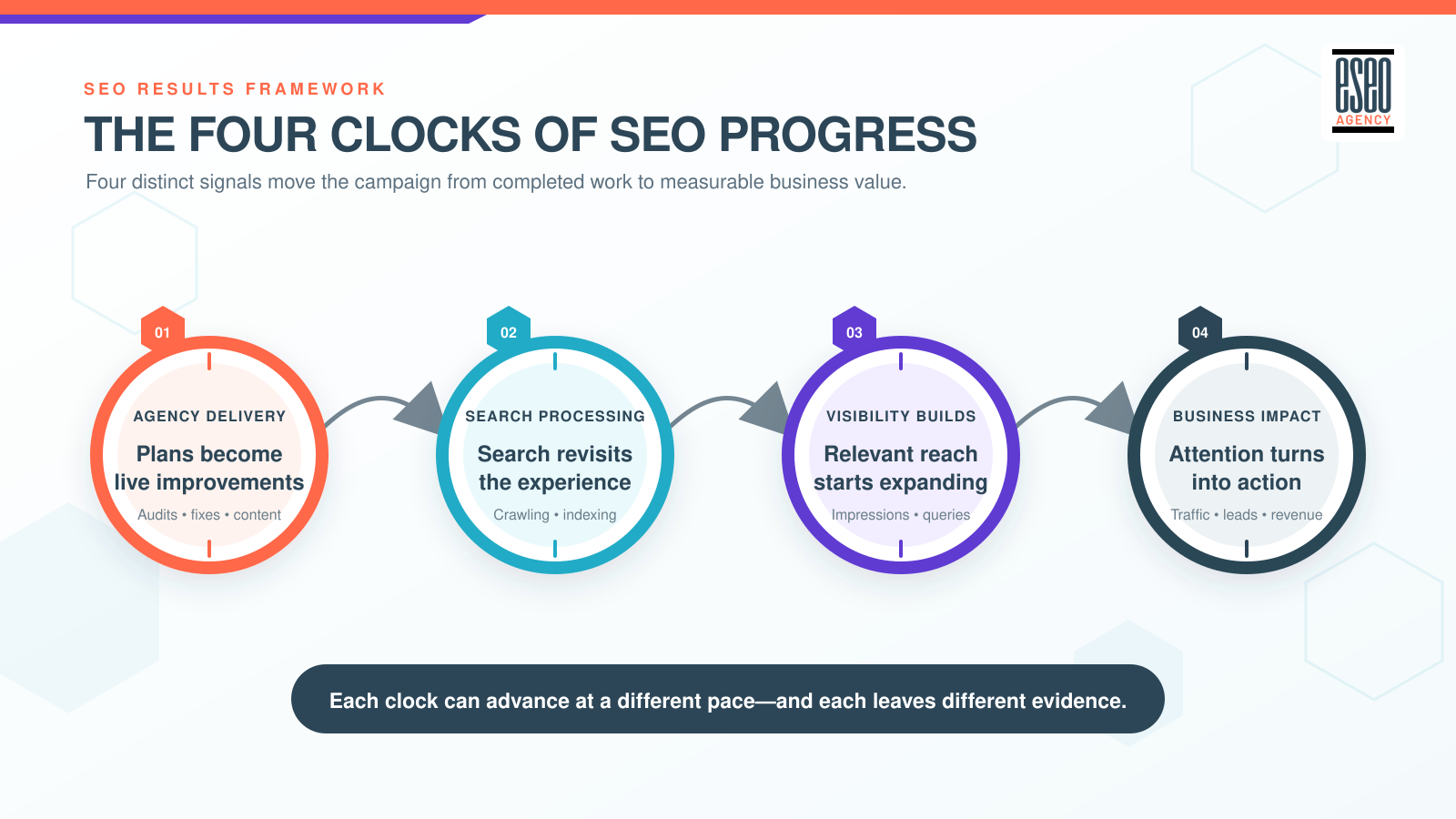
These outcomes develop through a sequence. Your agency must understand the site, establish measurement, prioritize opportunities, and put changes live. Search engines need time to discover and evaluate the updated pages. Visibility may follow, but exposure alone won’t ensure that the right people click, trust the offer, and act.
Each Part Advances At Its Own Pace
A technical correction completed today may remain absent from search data until the page is revisited. A service page may earn more impressions before clicks, while qualified traffic can rise before lead volume forms a reliable pattern.
Early reports should prove what changed, why it mattered, and which signals followed. Later reports should connect those signals to enquiries, sales, or other outcomes. Progress is credible when evidence develops across the campaign not when one favorable ranking appears without context.
Also Read: How Long Does SEO Take to Start Working?
What Must Be Measured Before the Work Begins?
An agency can’t prove improvement without a documented starting point. Before implementation begins, record organic clicks and impressions, ranking queries, landing pages, and URLs that are indexed or excluded. Separate branded searches from non-branded discovery, and document local visibility wherever geography shapes demand.
The commercial baseline matters equally. Configure analytics and conversion tracking to capture organic enquiries, calls, sales, bookings, conversion rates, and attributable revenue.
Review technical health, site performance, content, and the backlink profile so reports can distinguish progress from inherited strengths or unresolved weaknesses. Early On page SEO services in the USA should examine titles, page copy, internal links, indexability, search intent, and the experience awaiting visitors after they click.
A Brand-Name Ranking Doesn’t Prove Local Reach
Consider a Raleigh-area contractor that ranks for its business name but remains invisible for service-and-city searches. A national retailer might receive organic traffic while high-value product categories attract few impressions.
Neither total tells the full story.
Percentages need context. Increasing enquiries from one to two produces a 100% gain, but it represents only one enquiry. Credible reporting shows the starting values, absolute change, and business relevance alongside the percentage.
What Should the First 90 Days Produce?
The first quarter should turn strategy into an auditable work program. Depending on the campaign, deliverables may include:
- Verified analytics and conversion tracking
- Technical and content audit findings
- Search-intent and competitor research
- Keyword-to-page mapping
- Priority technical corrections
- Optimization of commercially important pages
- Content briefs and a production schedule
- Relevant local or e-commerce checks
- Confirmed benchmarks and reporting format
The production plan may include SEO Content Writing Services that answer customer questions and support relevant service or product decisions. Each brief should identify its audience, intent, purpose, expertise, and intended next step.
A dramatic traffic graph may not appear during these first 90 days, especially when substantial technical or structural work comes first. You should still receive an implementation record showing completed changes, affected URLs, priority reasoning, unresolved dependencies, and the next work queue.
Google’s SEO Starter Guide notes that changes may appear within hours or take several months, and generally recommends allowing a few weeks before judging their effect. That waiting period shouldn’t excuse inactivity. The agency should keep implementing, measuring, and clearly explaining the campaign while search data develops.
What Changes Commonly Appear Between Months Three and Six?
Businesses asking how long does SEO take to show results often watch months three through six because earlier work begins surfacing. Non-branded impressions can rise, new pages may enter the index, and the site may appear for more relevant queries.
Low-ranking pages may gain visibility. Improved listings can earn clicks as priority landing pages attract organic visits and initial enquiries or assisted conversions.
A service page may move from no impressions to appearing across related searches before calls become consistent. Such movement is useful evidence of visibility, but it isn’t proof of profitable growth.
Treat three to six months as a planning benchmark, not a deadline Google or an agency can guarantee. Campaigns may advance sooner, slower, or unevenly as pages, competitors, and demand respond differently.
What Different SEO Stages May Show
| Campaign Stage | Agency Evidence | Search Signals | Business Evidence |
| First month | Audit and benchmarks | Limited visible change | Baseline confirmed |
| Months 2–3 | Fixes and content deployed | Crawling and indexation | Early landing-page activity |
| Months 3–6 | Strategy refined | Impressions and query growth | Initial qualified conversions |
| Months 6–12+ | Expansion and iteration | Broader, steadier visibility | Leads, sales, and ROI patterns |
Why May Meaningful Growth Need Six to Twelve Months?
Meaningful growth often depends on improvements reinforcing one another rather than appearing instantly.
Over six to twelve months, the work may include:
- Expanding topical depth and refreshing underperforming content
- Building useful internal connections and improving service or category pages
- Identifying queries that attract valuable visitors
- Testing titles, calls to action, and page experiences
- Adapting to competitors and changing search-result layouts
Authority development moves at its own pace. Off-Page SEO Services may support relevant mentions, legitimate link acquisition, digital PR, and reputation signals. Links shouldn’t become a monthly quantity contest, though. Ten unrelated placements don’t automatically outweigh one credible editorial reference that fits the subject and supports a commercially important page.
Relevance, legitimacy, editorial context, and destination all matter.
Seasonality Can Distort Short Comparisons
Demand doesn’t remain constant throughout the year. Tax services, holiday retail, landscaping, and tourism each follow seasonal patterns. A three-month increase or decline may partly reflect customer behavior rather than the campaign alone.
Year-over-year comparisons help separate recurring demand cycles from developing organic performance, provided tracking and business conditions remain reasonably comparable.
Which Factors Can Shorten or Extend the Timeline?
SEO timelines depend on current site condition, market difficulty, and how quickly useful work reaches the public.
Major variables include:
- Starting condition: Website age, search history, technical debt, indexation problems, and previous spam, penalties, migrations, or redesigns
- Market difficulty: Competitor quality, search intent, geographic reach, and changing result layouts
- Available expertise: Content quality, access to subject-matter experts, and the accuracy of service or product information
- Execution capacity: Development resources, approval speed, budget, and campaign scope
- Commercial reality: Inventory or service availability, conversion quality, seasonal demand, and algorithm changes
Large stores introduce additional dependencies. eCommerce SEO services may need to address category architecture, faceted-navigation controls, canonicalization, product data, internal linking, discontinued items, and inventory changes before pages can compete consistently.
eSEO Agency is responsible for diagnosing those conditions, setting defensible priorities, maintaining implementation quality, communicating obstacles, and adapting the strategy as evidence develops. Crawling schedules, competitor activity, algorithm changes, and customer demand can influence the pace, so we account for those factors openly when interpreting progress and planning the next steps.
Two Websites Can Need Different Timelines
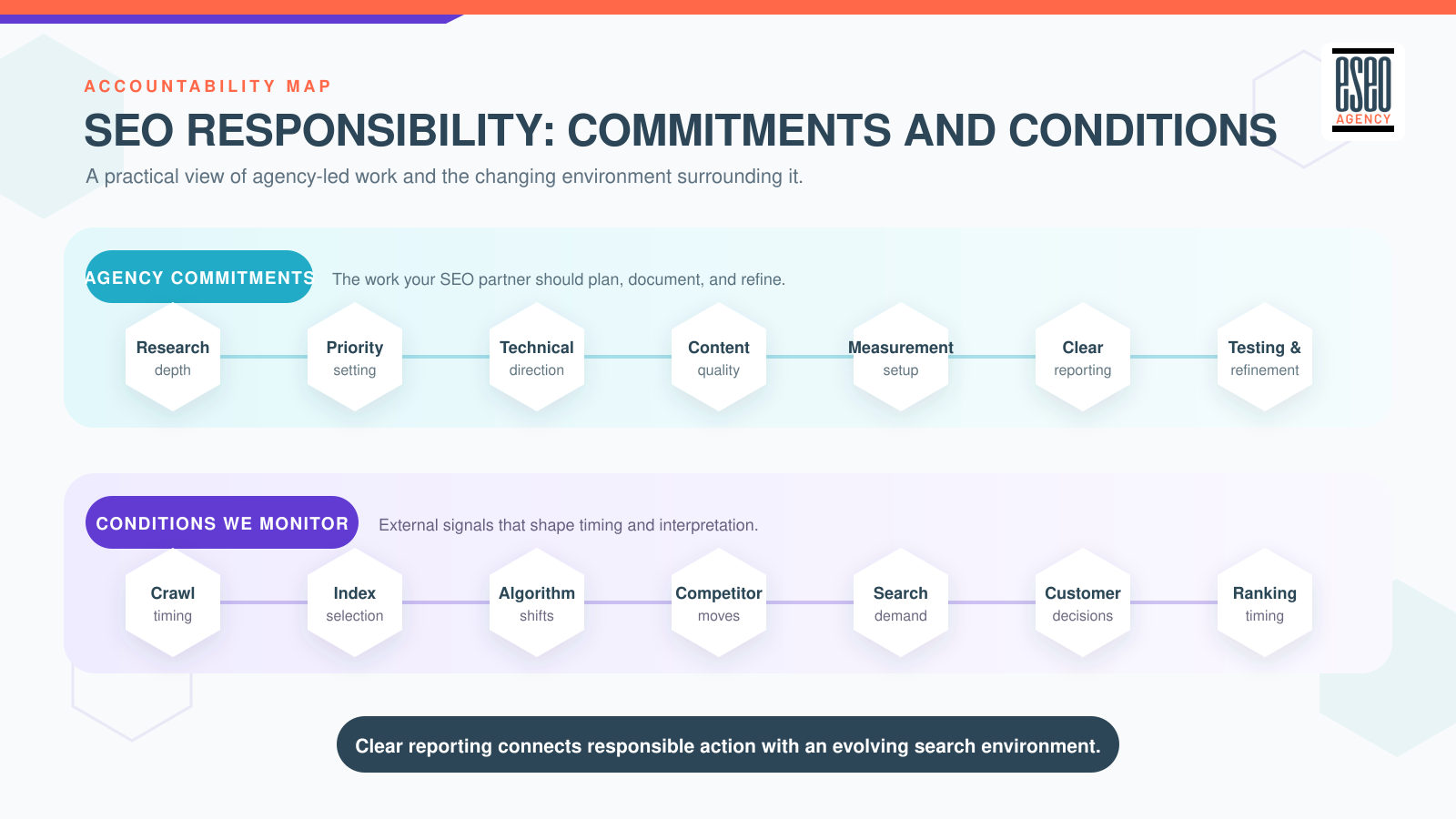
A technically healthy local company with accurate pages and prompt approvals may begin gaining relevant visibility sooner. A large retailer carrying duplicate categories, discontinued products, thin descriptions, and a developer backlog may need a longer foundational phase. Neither timeline proves greater effort by itself; the work required and the barriers delaying it provide the necessary context.
Why Does the Workstream Matter as Much as the Calendar?
A six-month timeline says little unless you can see what the agency is implementing. A complete program may connect:
- Access: Crawlable pages, technical foundations, and clear site structure
- Relevance: Helpful original content, page-level intent alignment, and internal linking
- Trust: Legitimate off-site authority and accurate local or product information
- Performance: Usable landing pages, conversion tracking, and visitor-behavior evidence
- Visibility: Opportunities across traditional results and AI-assisted search experiences
A broader program may include AI SEO Services, but AI visibility isn’t a separate shortcut or guaranteed outcome. Search eligibility, crawlability, useful original information, entity clarity, and accurate business or product data remain foundational. Newer discovery experiences still rely on information systems can access, interpret, and connect to a user’s need.
A campaign may slow when a dependency remains unresolved. Publishing more articles won’t compensate indefinitely for blocked pages, vague service information, disconnected internal links, inaccurate product data, or broken conversion tracking. Reports should identify incomplete components and explain how each task supports the customer journey rather than merely filling a monthly quota.
Also Read: Top SEO Techniques for Enhanced Website Visibility
What Should a Credible SEO Report Show?
A credible report should connect agency activity, search behavior, and business impact. A polished screenshot showing google ranking improvement may look encouraging, but one query at one moment can’t demonstrate a campaign’s health or commercial value.
A useful reporting structure covers:
- Implementation: Work completed, pages affected, and technical issues resolved or still open
- Search performance: Impressions, clicks, click-through rate, average position, and movement across relevant queries
- Business response: Priority landing-page activity, calls, leads, sales, and assisted conversions
- Interpretation: Meaningful observations, possible causes, next priorities, and any client actions needed
Ranking tools can help monitor queries, but their snapshots may change by location, device, personalization, result type, and time. Search Console shows aggregated data from Google Search appearances. Google’s Search Console performance-report guidance explains how impressions, clicks, average CTR, and average position are defined.
Context matters in every comparison. Review the recent period against the prior period, add year-over-year analysis for seasonal businesses, and separate branded from non-branded discovery.
Compare priority pages with sitewide totals, then place leads and revenue beside traffic. These views help prevent one week, one popular article, or one branded surge from disguising the campaign’s broader direction.
How Should Traffic, Leads, and AI Visibility Be Interpreted?
Rankings matter when they help the right people discover a relevant page. Investments in organic search ranking improvement services should follow a commercial journey:
Visibility → qualified clicks → useful page engagement → enquiry or purchase → revenue
Traffic can increase without producing a comparable rise in leads. Common causes include:
- Growth concentrated in informational queries
- Pages targeting weak commercial intent
- Unclear offers or calls to action
- Mobile friction that interrupts the journey
- Untracked calls or form submissions
- Prices or service areas that don’t match expectations
AI summaries add another layer to interpretation. Pew Research Center’s AI-summary click analysis examined March 2025 browsing data from 900 U.S. adults. Users clicked a search result on 8% of pages containing an AI summary, compared with 15% of pages without one. This suggests click behavior is changing, not that organic visibility has stopped influencing research, brand recognition, or later decisions.
Interpret search performance through multiple outcomes. Track non-branded discovery, branded demand, qualified leads, assisted conversions, AI visibility where trackable, and attributable revenue. Visits still matter, but their source, intent, destination, and contribution to a decision reveal far more than the total alone.
Also Read: SEO vs. Google Ads: Understanding Organic vs Paid Search
How Can You Tell Healthy Patience From Poor Performance?
Businesses asking how long does SEO take to show results should look beyond the calendar. Healthy patience produces visible evidence; poor performance leaves activity and decisions difficult to verify.
Healthy Signs
|
Warning Signs
|
Timing can reflect shared dependencies. Slow approvals, unavailable developers, missing analytics access, delayed subject-matter input, or paused publishing may hold back work. A responsible agency should identify these constraints early, explain their effects, and help the client find a route forward.
Google’s guidance for hiring and evaluating an SEO recommends asking about methods, measurement, timeframes, market experience, prior work, and realistic estimates. It advises avoiding providers that guarantee first-place rankings. Expectations, implementation, evidence, and communication help distinguish patience from poor performance.
Get an SEO Timeline Built Around Your Business
Your campaign deserves a timeline shaped by its condition, market, and priorities not a date borrowed from another website. eSEO Agency brings together technical review, page optimization, content development, authority building, e-commerce support, and AI-search planning through customized programs for U.S. businesses.
Our team uses data-informed reporting, ongoing refinement, and transparent communication to explain completed work, developing evidence, and next priorities clearly.
Tell us about your website, priority services or products, target locations, current search performance, and measurable business outcomes. We’ll help you identify the best starting points and establish practical milestones for the work ahead.
Get a Quote or discuss your next steps with our team at (252) 513-9681.
Frequently Asked Questions
What should an SEO agency include in its first report?
The first report should establish benchmarks and document completed work, affected URLs, technical findings, early performance data, unresolved dependencies, and upcoming priorities. Limited initial data should be presented as an early signal rather than proof of lasting traffic, lead, or revenue growth.
Should I sign a 12-month SEO contract before seeing results?
A 12-month agreement may suit a campaign requiring extensive onboarding and implementation, but the term should align with the actual scope. Review the deliverables, reporting schedule, evaluation points, account ownership, cancellation conditions, renewal language, and exit support before signing.
Does a larger SEO budget always produce faster progress?
A larger budget may fund more research, content, development, or outreach at once, increasing implementation capacity. It doesn’t guarantee faster crawling, indexing, rankings, or customer demand. Site condition, competition, approval speed, strategic focus, and execution quality continue to influence progress.
Can I change SEO agencies without losing existing progress?
Yes. Preserve access to your analytics, Search Console, website, content, credentials, strategy documents, backlink records, reports, and implementation logs. A documented handover helps the incoming agency understand completed work, maintain useful assets, identify unfinished priorities, and reduce avoidable disruption.
Who should own my SEO accounts and website data?
Your business should retain primary ownership and administrator access for its domain, website, analytics, Search Console, Google Business Profile, advertising accounts, call-tracking platform, and other essential systems. Give agencies appropriate access without making them the sole owner of business-critical data or accounts.
How can I confirm that leads came from organic search?
Use properly configured analytics, form tracking, call tracking, CRM source fields, landing-page data, and assisted-conversion reporting. Compare those records with actual sales conversations and customer intake information. No single platform captures every multistep journey perfectly, so several sources may need reconciliation.
Can an SEO agency guarantee page-one rankings by a set date?
Page-one placement by a fixed date isn’t a result any agency can responsibly guarantee. Rankings respond to many changing signals and competitive conditions. A credible agency can commit to agreed deliverables, quality standards, transparent reporting, and evidence-led strategic adjustments.
What should I bring to an SEO consultation?
Bring your business objectives, priority services or products, target locations, customer questions, known website problems, previous reports, and available access details. Lead values, sales cycles, internal resources, approval requirements, and a realistic budget range will help the agency recommend an appropriate scope.